













Web3 has always moved in cycles, not straight lines.
2017–2018: ICOs
2020–2021: DeFi & Yield Farming
2021–2022: NFTs
2023–2024: Memecoins & Airdrops
2025–2026: Prediction Markets
Each cycle follows the same pattern:
experimentation → liquidity → tooling → professionalization.
Right now, prediction markets are entering the professionalization phase.
And at the center of this shift sits Polymarket, which has quietly become one of the most capital-efficient markets in Web3.
This article explains why prediction markets are shaping up to be the next dominant niche in Web3 for 2026, how traders are making real money, how bots and copy trading work, and why timing, not prediction, is the real edge.
What Are Prediction Markets
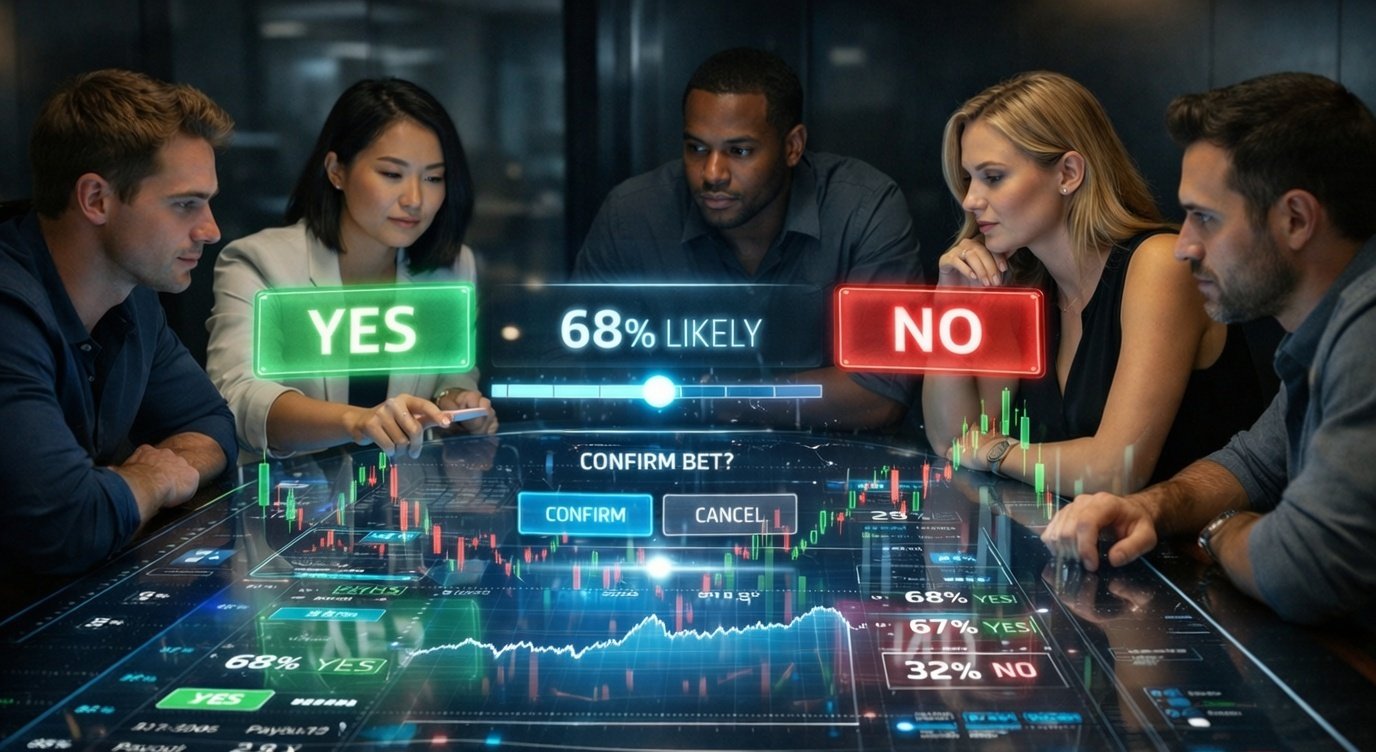
A prediction market lets users trade on future outcomes.
Instead of buying a token and hoping price goes up, you trade probabilities:
“Will BTC be above $70,000 on December 31?”
“Will an ETF be approved before March?”
“Will a court case resolve YES or NO?”
Each outcome trades between $0.00 and $1.00:
$0.30 = 30% probability
$0.70 = 70% probability
If the outcome resolves YES, YES shares settle at $1.
If NO, they settle at $0.
This turns information, timing, and uncertainty into tradable assets.
On-chain prediction markets add:
Transparent settlement
Global access
Automation via scripts and bots
Verifiable performance
Why Prediction Markets Are Exploding Now
Prediction markets are not new, but conditions are finally right.
1. The World Is Permanently Uncertain
Elections, regulation, wars, ETFs, AI policy, macro shifts, uncertainty is no longer temporary.
Prediction markets monetize uncertainty directly.
2. Information Moves Faster Than Narratives
On X, Discord, and news feeds, information breaks before consensus forms.
Prediction markets lag, and that lag creates edge.
3. Automation Works Better Than Emotion
YES/NO markets are easier to automate than spot trading:
Clear outcomes
Defined max risk
Binary settlement
This makes them ideal for bots, scripts, and copy trading.
Polymarket: The Center of the Prediction Market Cycle
Polymarket is currently the largest and most liquid crypto-native prediction market.
Platform URL:
https://polymarket.com/
Key characteristics:
On-chain settlement
High-liquidity political, crypto, macro, and event markets
Transparent trader histories
Public profit and loss (PnL) per wallet
This transparency is what enabled the strategies below.
Proof #1: $50,000 in One Month From Consistent Trading
One trader earned ~$50,000 in a single month on Polymarket by trading across many markets, not by hitting one lucky bet.
Source (public profile):
https://polymarket.com/@bamesjond?via=mop-ozeu
Why this example matters:
Trades across dozens of markets
No “all-in” positions
Repeated small edges
Demonstrates repeatability, not luck
This profile is frequently cited by copy traders as a model account.
Proof #2: $18,000,000+ Combined PnL From Verified Traders
Researchers identified 50 Polymarket wallets linked to verified Twitter/X accounts.
Combined realized PnL:
$18,000,000+
Examples (publicly traceable wallets):
Top-Tier Performers ($1M+)
@AnselFang — $3.18M
visit users profile@HarveyMackinto2 — $2.29M
visit users profile@scottonPoly — $1.34M
visit users profile@debased_PM — $1.11M
visit users profile
High Six–Figure Performers ($400K – $1M)
@AnjunPoly — $969K
visit users profile@friendlyping — $951K
visit users profile@denizz_poly — $494K
visit users profile@Eltonma — $463K
visit users profile@BrokieTrades — $410K
visit users profile
Mid Six–Figure Performers ($250K – $399K)
@influenzEth — $395K
visit users profile@Feifeitian_0924 — $326K
visit users profile@player1 — $311K
visit users profile@Frank3261939249 — $285K
visit users profile@verrissimus — $266K
visit users profile@traXeH_ — $266K
visit users profile
Consistent Six–Figure Performers ($150K – $249K)
@Nooserac — $240K
visit users profile@Parz1valPM — $218K
visit users profile@cashyPoly — $204K
visit users profile@cynical_reason — $195K
visit users profile@elucidxte — $186K
visit users profile@JJo3999 — $183K
visit users profile@AbrahamKurland — $175K
visit users profile@MiSTkyGo — $174K
visit users profile@HanRiverVictim — $157K
visit users profile@Bambardini — $155K
visit users profile@CSP_Trading — $153K
visit users profile@wkmfa57 — $150K
visit users profile
Emerging & Smaller Six–Figure Wallets ($75K – $149K)
@jongpatori — $141K
visit users profile@polytalvi — $138K
visit users profile@OxyPredicts — $136K
visit users profile@polymarketbet — $134K
visit users profile@PatroclusPoly — $129K
visit users profile@EricZhu06 — $128K
visit users profile@archaic_on_Poly — $120K
visit users profile@gnome_labs — $118K
visit users profile@VespucciPM — $117K
visit users profile@evan_semet — $114K
visit users profile@default717 — $104K
visit users profile@ChineseMethod — $103K
visit users profile@MonteCarloSpam — $99K
visit users profile@mango_lassi — $97K
visit users profile@thanksforshow_ — $86K
visit users profile@ThePrexpect — $85K
visit users profile@tupac_poly — $85K
visit users profile@Hans323 — $84K
visit users profile@Roflan_ludoman — $82K
visit users profile@JAHODA_J — $77K
visit users profile@kekkospoly — $77K
visit users profile@JohnnyTenNums — $77K
visit users profile@xK0neko — $76K
visit users profile
These are not screenshots.
They are on-chain, auditable trading records. Ready to copy-trade using the TradeFox prediction market copy trading tool!
Read more about TradeFox in THIS ARTICLE.
Why Copy Trading Is Exploding on Polymarket
Because Polymarket exposes:
Wallet histories
Entry timing
Position sizing
Win/loss ratios
Copy trading becomes trivial to automate.
Instead of predicting outcomes, users ask:
“Who consistently prices probability better than the market?”
That question has answers, on-chain.
How Polymarket Bots Actually Make Money
There are three dominant bot strategies currently used.
1. Cross-Market Arbitrage Bots
What they do:
Compare Polymarket prices with centralized exchanges (Binance, Bybit).
Example:
BTC spikes on Binance
Polymarket BTC-up market lags
Bot buys outdated YES prices
Repricing happens minutes later
Edge: latency, not prediction.
2. Classic Probability Arbitrage
What they do:
Buy near-certain outcomes priced below $1.00.
Example:
Market trades at $0.95–$0.98
Event resolution is highly likely
Profit: 2–5% per trade
This scales well with capital and automation.
3. Copy Trading Bots
What they do:
Automatically mirror trades from profitable wallets.
Core requirements:
High win rate
Controlled drawdowns
Broad market participation
Execution is easy.
Trader selection is everything.
Proof #3: $125 → $357,000 via Timing, Not Prediction
One of the most cited Polymarket success stories:
$125 initial capital
Grew to $357,000
Strategy: information timing, not outcomes
Source reference:
https://polymarket.com/
(Trader discussed publicly on X under @euanker)
Additional example:
Closed an $84,000 win on a highly chaotic market
Built positions before narratives stabilized
Exited during forced consensus repricing
Core principle:
Money is made before certainty, not after.
The Core Meta: Timing Beats Narrative
Across all profitable traders, the same pattern appears:
Buy during information fragmentation
Sell during consensus convergence
Ignore headlines
Trade probability shifts, not beliefs
This mirrors professional trading desks, not retail gambling.
Advanced Strategies Emerging for 2026
As tooling improves, traders are deploying:
Micro-betting across dozens of markets
Correlated outcome hedging
Liquidity timing around news drops
Partial exits during repricing
Multi-wallet risk isolation
Scripted rebalancing
Prediction markets are evolving into information trading systems.
Why Prediction Markets Are the Web3 Niche of 2026
Prediction markets:
Financialize uncertainty
Reward information speed
Scale with automation
Are transparent and auditable
Reduce reliance on hype cycles
They attract:
Traders over gamblers
Analysts over influencers
Builders over promoters
Just like DeFi replaced ICO speculation, prediction markets are replacing narrative trading.
Final Thoughts: Position Before Consensus
Every Web3 cycle rewards those who recognize the shift early.
Prediction markets are no longer experimental, they are already producing verifiable results, scalable systems, and professional traders.
The narratives have not peaked yet.
The tooling is still improving.
Liquidity is still concentrating.
That combination only exists before a cycle becomes mainstream.
For 2026, prediction markets are no longer a question of if,
only who positions early enough.
Comments